

I lost money to a casino once, and even though it happened at the cashier and not at the table, I still remember being annoyed. My bankroll was roughly $60, but I had gotten that amount up to more than $400 using a flashier banner ad to lead me to the site. Once I requested a withdrawal, the casino asked for a utility bill and then a picture of myself holding my identification card, and then a “Source of Funds” document. Then, I simply heard crickets. My account eventually reflected a zero balance and noted a “Bonus Abuse” violation for a bonus I’d never even taken advantage of.
It was quite some time ago. And it taught me perhaps the most important thing I’ve learned about the gaming industry: a trusted casino is the one that can back up what it claims. Therefore, this is the checklist I use today. Over several years of signing up, testing support, checking terms that nobody seems to read, and occasionally having to fight to receive my winnings, I developed the following checklist:
Why Casino Trust Is About Proof, Not Promises
Each casino states that it’s safe. Each footer displays a line of logos. Each homepage boasts fast payouts and fair games. All of those mean very little unless you investigate it, and fortunately, most of it can be investigated within approximately ten minutes.
I approach online casino legitimacy in a very straightforward manner. A legitimate operator provides documentation for its existence (i.e., a license that can be verified, a company name that can be searched, third-party lab-test certificates for the games offered, and terms and conditions that an average individual could understand.) An illegitimate casino — or simply a lazy one — creates gaps. Below are the ten ways I identify potential gaps.
1. Verifiable Gaming License
The one indicator of legitimacy that is paramount to all others is a valid gaming license. People typically check this in the easiest possible manner — by looking at the logo.
Go down to the bottom of any casino site. Legitimate casinos include the licensing authority along with the license number, as well as the name of the legal entity that possesses said license (in most cases something akin to “Operated by XYZ Entertainment Limited, Registered in Malta, Company Number C123456“). If any piece of that triad is missing, that is already a yellow light. Next, you’ll need to verify it yourself. Do NOT click on the seal and blindly trust whatever page it leads you to because false seals which link to false verification pages are prevalent. Instead go directly to the regulator’s website and search their public register. The U.K.’s Gambling Commission maintains a public register where you may query businesses either by name or by account number. The Malta Gaming Authority includes its licensees in its public register and MGA license numbers are formatted similarly (e.g., MGA/B2C/123/2018). The Gibraltar Regulatory Authority, Alderney Gambling Control Commission and the Isle of Man Gambling Supervision Commission maintain lists of licensed operators. In the United States, each state regulates online casinos differently, however the New Jersey Division of Gaming Enforcement, Michigan Gaming Control Board, Pennsylvania Gaming Control Board and West Virginia Lottery each post approved websites.
While licenses vary in regard to legitimacy, they do provide varying levels of assurance. A license issued by the U.K.G.C. or by a U.S. State Regulator indicates adherence to stringent rules regarding advertising, treatment of player deposits/funds, age and identity verification and anti-money laundering, as well as strict enforcement. Although MGA is considered to be on par with those two regulatory bodies with regards to the enforcement of rules regarding player protection (MGA has a proper complaint resolution department), neither can compare to U.S. State Regulators‘ ability to suspend or fine operators.
2. Independent Game Audits and RNG Certification
All digital slots, roulette wheels, etc., utilize Random Number Generators (RNGs) to determine outcomes. Thus, the logical next question would be whether anyone outside of the casino verifies that RNG is functioning randomly. Reputable casinos have independently tested their RNG(s).
3. Transparent Providers and Published Return To Player Rates
An excellent casino lobby will tell you who produced each game. You’ll likely recognize names from prominent studios; there will likely be filters available for the providers used; and you’ll probably be able to access information screens showing the Return To Player rate for each game. This is significant because major studios are picky about where their games are allowed to be displayed. Major studios have their own licenses and compliance departments; thus, many major studios refuse to supply operators in jurisdictions where those operators are not licensed. Therefore, seeing a large number of recognizable and reputable providers in a lobby is essentially an indication that the casino has successfully completed another party’s Due Diligence.
4. Website Security; Payment Security; Account Protection
Let’s get the fundamentals out of the way. The site should load securely via HTTPS (you’ll see a padlock in your browser bar) and remain secure throughout your browsing experience; particularly on sensitive pages (login, registration, cashier, etc.). While modern TLS encryption (SSL still gets referred to by many as SSL) protects data transmitted between your browser and the casino during your session; HTTPS alone does not serve as a trust signal. Cheap/free certificates are easily attainable and require minimal effort to obtain. Phishing sites display padlocks as do scam/casinos displaying padlocks. The padlock indicates that your connection is secure; it indicates absolutely nothing concerning who is on the receiving end of that secure connection. Lack thereof is a deal breaker; possession thereof signifies virtually nothing. More relevant indicators pertain to payments and accounts. Consider which payment methods are supported by the casino.
6. Clear Bonus Terms and Conditions
Bonuses are where good casinos resemble predators in regards to their homepage representations; yet differ greatly in regards to their small print representations. The primary consideration relative to bonus terms is the Wagering Requirement (the number of times you must place wagers with your bonus [and/or deposit] prior to requesting withdrawal). Example: $100 bonus @ 35x bonus = $3500 in wagers. Example: $100 deposit + $100 bonus @ 35x deposit + bonus = $7000 in wagers. That one variable increases workload nearly by half. For perspective purposes: U.K.-regulated bonuses have been capped at 10x wagering requirements.
7. Proper Identity Verification (KYC); Account Security
Individuals dislike verifying identities as much as individuals dislike performing KYC processes (Know Your Customer). However, a casino that never requests who you are is indicative of greater concerns than a casino that requests too soon.
Regulated casinos are obligated to perform KYC procedures related to age verification, identity verification and anti-money laundering compliance. In heavily regulated markets (such as the U.K.), KYC processes are frequently required prior to allowing you to make deposits or engage in gameplay. In less-regulated markets, KYC procedures typically occur subsequent to your initial withdrawal or upon reaching a certain threshold. The distinction between compliant KYC procedures versus abusive KYC procedures relates primarily to timing and clarity of communication. Good casinos inform users ahead of time what forms of documentation they require (typically photo ID, proof of residency and/or proof of funding mechanism); how lengthy the review procedure will be; and allow users to initiate/reinitiate KYC procedures at any time. I prefer to complete KYC shortly after registering but before making a deposit.
If completing KYC proves difficult or chaotic, I consider myself fortunate.
8. Actual Functionality of Responsible Gambling Tools
Casino policies that allow users to restrict their spending are essentially synonymous with policies designed to avoid extracting every last penny from users; therefore, I treat Responsible Gambling Tools as a trust factor rather than merely an ethical component. Search for Deposit Limits (Daily/Wk/Mo), Loss Limits, Wager Limits, Session Limits, Reality Checks (pop-up notifications indicating duration spent playing), Cool-Off/Tim-Out periods and Self-Exclusion functionality in your account settings. Those items should be readily accessible; should become effective immediately upon modification; should feature delays prior to modifying limits (at minimum 24 hours.)
9. Supportive Customer Support with Real Escalation Pathways
Ultimately, you discover how valuable your support is when something occurs incorrectly; the secret lies in discovering that prior to an issue occurring incorrectly. Test it out — inquire via Live Chat regarding one specific item that you can verify (for example: “What is the pending time frame for Skrill Withdrawals? Are there any fees?”) or (“Which RTP Version Does Your Copy of [Specific Slot Title] Run?”). The ideal Agent responds promptly and accurately or advises you that he/she will research it. A poor Agent replies with canned responses; evades providing direct answers; or contradicts the stated terms/conditions. I’ve spoken with Agents who claim there were no withdrawal fees from Skrill while stating in their terms/conditions a 3% withdrawal fee existed from Skrill.
10. Consistent Reputation Regarding Players
Lastly: what do other players state? The term that I am searching for here is consistency. Individual reviews are noise; testimonials posted on the casino’s site are marketing; a review criticizing a casino after losing money is also noise. What I am searching for is complaint patterns — numerous players across multiple months reporting similar issues (delayed withdrawals; winnings voided; “bonus abuse” explanations).
Red Flags Indicative of Unsafe Online Casinos Worth Stepping Away From
As indicated previously, most red flags associated with scams indicate the exact opposite characteristics of the preceding ten indicators; however, some should be identified specifically because they repeatedly appear on scam sites.
- Should I observe any of these features at a site I’m considering, I will not fund it:
- Missing/unverifiable/non clickable seal;
- Non-matching license # at regulator’s website;
- No identifiable company behind website;
- Copy/Pasted T&Cs from another casino;
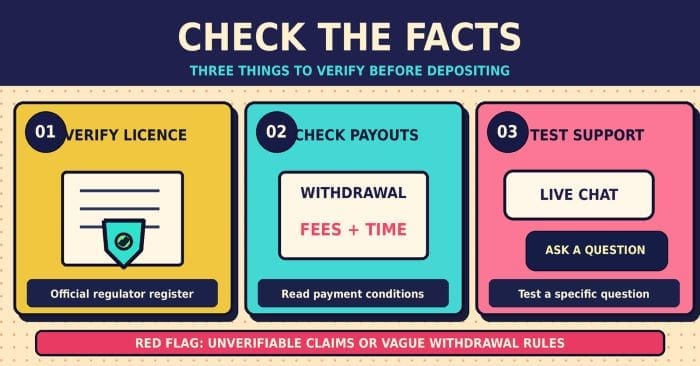
- Vague/slow Withdrawal Rules;
- Rules permitting operator to void winnings for reasons defined as necessary;
Unrealistically high promises; i.e., guaranteed wins; Huge Bonuses with no clearly stated wagering requirements; Urgency to deposit “now”.
Ten-Minute Check Before Depositing Anywhere New
To facilitate identifying potentially problematic casinos faster than most alternatives and with fewer problems encountered thereafter; this is how I think about checking online casinos for legitimacy prior to funding them:
- Verify License Number and Operator
- Name at Regulator’s Official Site
- Review Withdrawal Policy Regarding Pending Periods/Limits/Fees/Matching Payments
- Engage Live Chat and Ask One
- Specific Question Which Can Be Verified
- Research Deposit Limits and Self
- Exclusion in Account Settings
- Perform Search on Casino Name Plus “Withdrawal Complaint”; Identify Patterns.
Frequently Asked Questions
Is a casino online trustworthy?
Check for your casino’s license first as everything else will fall into place from there. Check the license number and casino operator on the regulator’s web site to see if they have independently tested their games, clearly outline how withdrawals work, provide responsible gaming tools, and have good customer service. There isn’t just one test you need to pass for a casino to be trustworthy, you would expect most tests to be passed easily.
Where can I verify my online casino license, and where can I find the license number?
The license number should be at the bottom of the home page of your casino. The company name may also be listed either at the bottom of the home page or in the “About Us” section of your casino. Once you have both numbers go directly to the regulator’s official web site and search the public registry using the license number. Ensure the status of the license is active and the company name listed corresponds to each other.
What is RNG Certification, and Why Is It Important?
RNG Certification is when an independent laboratory verifies that the Random Number Generator used to generate results for all of your casino games generates true randomness. This means that the games mathematically produce returns based on actual probability rather than being manipulated by someone who has access to the system. If a casino doesn’t have RNG certification, you are going to have to trust that they are telling you that none of their games are fixed.
What Are eCOGRA And GLI Certification?
eCOGRA is an independent organization that provides Safe & Fair seal and Player Dispute Service certifications. GLI (Gaming Laboratories International) is one of the larger third party organizations which certify games and systems for regulators around the world. Both certifications mean something positive about a casino, as long as the certification itself can be confirmed.